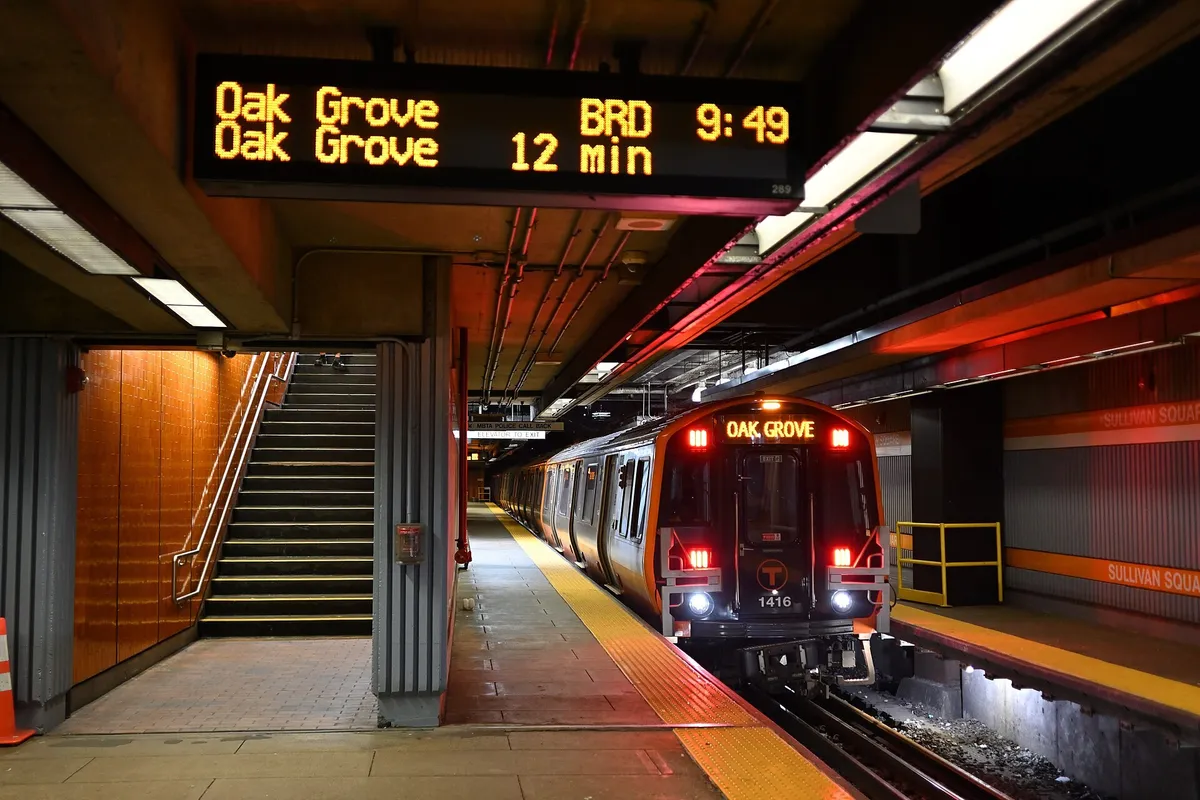
MBTA tops 1 million weekday trips for the first time since February 2020
By The Boston Digest
The MBTA averaged more than 1 million passenger trips each weekday in October, a level the T hadn't reached since February 2020, General Manager Phillip Eng told the agency's Board of Directors on Thursday, Nov. 19.
That's 4 percent more than in September and 9 percent more than in October 2025, the MBTA's announcement said.
Gov. Maura Healey called it "a major milestone for the T and a clear sign that our investments in public transportation are making a difference."
Trains are moving faster and service is more dependable, she said, and "riders are coming back."
Eng is also Interim Secretary of Transportation. He credited better service, and people choosing to ride public transit. "Improved service means that more riders can count on the T to get them where they need to go," he said.
Through the 2024 Track Improvement Program, the T lifted more than 220 speed restrictions.
Speeds went up to 55 mph on the Orange Line north of North Station and to 50 mph on parts of the Red Line.
Catenary wire that had hung for 130 years was replaced, and work to modernize the subway's signal systems is still underway.
Buses changed too. Dozens of routes got more service hours, simpler paths or more frequent trips.
On the harbor, riders gained a new option: the Harbor Loop, a ferry route that runs year-round.
Fares were part of the push. "Affordability has also played a key role in growing ridership," the MBTA said.
Riders gained the Income-Eligible Reduced Fare program and the Car-Free Seniors initiative, along with a two-hour window for transfers and no higher fares on express buses. Commuter Rail riders got discounts, too.
Away from the tracks, the MBTA has teamed with local developers on 6,050 homes, 1,325 of them affordable, plus 10.1 million square feet of commercial space.
"Our work is not done, and we hope to see ridership continue to increase," Eng said.
You might also like RELATED
Recommended to you
Boston police arrest 17-year-old on gun charges after Mattapan foot chase
A 17-year-old ran from District B-3 officers near Erie Street...
Boston police seek missing Dorchester woman, 27, last seen leaving home Oct. 21
Aquilat Moore-Albert, 27, has not been home or in touch...
Boston police seize loaded machine gun with defaced serial number in Dorchester
District B-3 officers found a loaded Glock fitted with a...

Bostonians can nominate stories for 25 permanent historic markers through Jan. 29
Boston residents can nominate people, places, events and communities from...